A due anni dalla prima edizione, il Laboratorio di "Teorie e Metodi di analisi delle reti sociali" del Dipartimento di Scienze Politiche e Sociali, organizza la Seconda Edizione del Corso"Introduzione all'analisi delle reti sociali" che si terrà a Pisa dal 20 al 23 Settembre 2011. Sono disponibili 15 posti; la data di scadenza per registrarsi è il 20 luglio 2011.
Il corso sarà interamente in lingua italiana.
Il programma, il modulo di registrazione ed altre informazioni utili sono disponibili alla pagina del Workshop (Vai alla pagina).
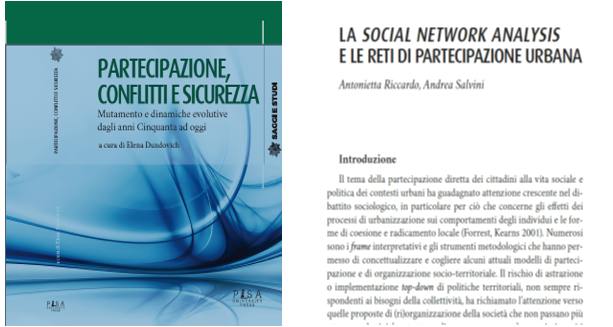
Nuove pubblicazioni (curate dai membri del Laboratorio)
Si segnala l'uscita di due pubblicazioni a cura di alcuni collaboratori del Laboratorio, che riguardano la SNA:
Dania Cordaz, Dati e processi. Sull'integrazione tra metodi quantitativi e metodi qualitativi nelle scienze sociali, FrancoAngeli, MIlano, 2011
Andrea Salvini,
Symbolic Interactionism and Social Network Analysis: an Uncertain Encounter, in "Symbolic Interaction", Vol. 33, n. 3, 2010
ARS'11
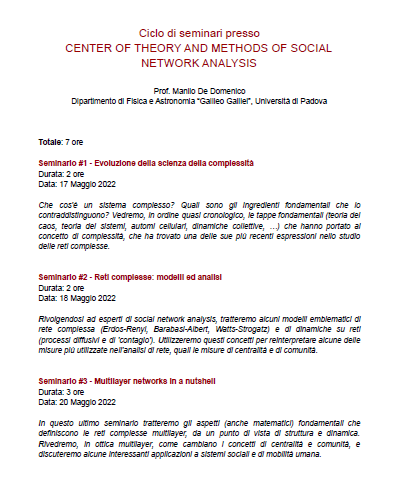
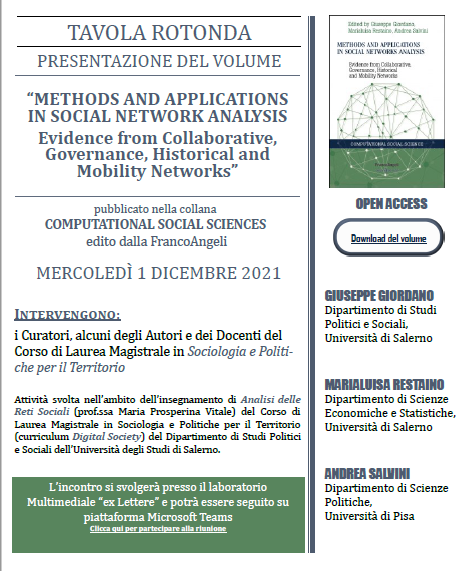
Si terrà a Napoli dal 23 al 25 giugno 2011 il terzo Workshop Internazionale sull'analisi delle reti sociali organizzato dall'Università di Salerno, dedicato quest'anno a: "Collaboration Networks and Knowledge Diffusion: Theory, Data and Diffusion".
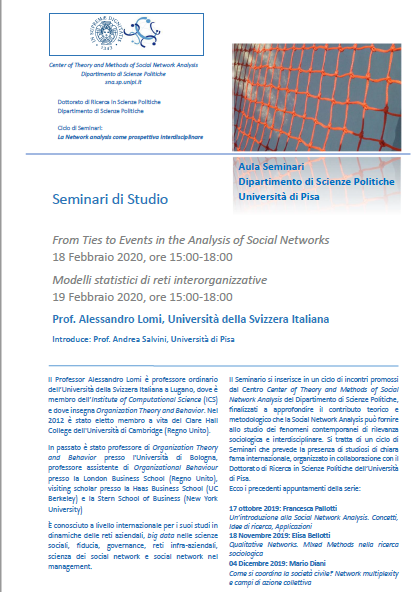
CICLO DI "LEZIONI INTERDISCIPLINARI PER LO STUDIO DELLE INTERAZIONI E DELLE RETI SOCIALI"
Il Dipartimento di Scienze Sociali dell'Università di Pisa, la Sezione "Teorie e metodi di analisi delle reti sociali" e il Dottorato di ricerca in Storia e Sociologia della Modernità della Facoltà di Scienze Politiche organizzano un ciclo di "Lezioni interdisciplinari per lo studio delle interazioni e delle reti sociali" nei mesi di marzo-maggio 2009.
Nella pagina dedicata alle lezioni verranno di volta in volta pubblicati i materiali dei docenti (presentazioni, sintesi delle relazioni...)
WORKSHOP ARS 09 - Università di Salerno
Il 13 e 14 luglio si terrà all'Università di Salerno il Workshop ARS 09: "Analisi delle reti sociali: modelli e metodi per trattare dati relazionali". A circa un anno e mezzo di distanza dalla prima, riuscita, edizione, verrà organizzato un secondo momento di incontro che si preannuncia assai interessante.
Il Workshop ARS'09 sarà preceduto da Tutorial sui software: Pajek, Siena, Ucinet che saranno tenuti in sessioni parallele lunedì, 13 luglio 2009 (9.00-13.00).
Qui il link alla pagina web del Workshop da cui si può scaricare il Call for Paper; per maggiori informazioni mandare una e-mail a ars09@unisa.it.
Pagina delle risorse multimediali
Inserita nel sito, in via sperimentale, una nuova Sezione contenente materiali multimediali (lezioni, conferenze, ecc...) relative all'analisi delle reti sociali (vai alle risorse multimediali)
Inserite due risorse video, relative ai Seminari:
"Teoria dei grafi per l'analisi delle reti sociali" e
"Analisi multilivello per lo studio delle reti sociali
Analisi multilivello per lo studio delle reti sociali
Aula Magna - Sede staccata Dipartimento di Scienze Sociali
14 maggio 2008
Tecniche di simulazione e reti sociali
Aula Magna - Sede staccata Dipartimento di Scienze Sociali
15 maggio 2008
Eventi passati
Teoria dei grafi per l'analisi delle reti sociali
Aula Magna - Facoltà di Scienze Politiche, Università di Pisa
17 aprile 2008
Il Laboratorio di studi rurali "Sismondi" del Dipartimento di Agronomia e Gestione dell'Agroecosistema organizza una giornata di studio dal titolo
Analisi delle reti sociali. Teorie, metodologie e qualche applicazione
24 aprile 2008
Convegni
Home
NEW BOOK!
A. Salvini, A. J. W. Andersen (Eds.), Interaction, Health and Community, PLUS, Pisa, 2011.
In 2009, the University of Pisa and the University of Agder (Norway) signed an agreement of collaboration in order to enhance relations between the two universities and develop academic and cultural interchange in the areas of education, research and other activities within community studies, psychosocial work and mental health. The agreement emerged from a longer collaboration between user-organisations and mental health practitioners in the two countries. The collaboration was extended and strengthened by an Erasmus agreement in 2011.
As the first concrete result of our collaboration, we are proud to launch a new book synthesizing reflections on “Interactions, Health and Community” (Eds. Andrea Salvini, Anders J. W. Andersen, Edizioni PLUS, Pisa, 2011).
SUMMARY
Preface
NORWAY, ITALY
di Mario Aldo Toscano
Introduction
di Andrea Salvini, Anders Johan W. Andersen
Part I
DISCOURSES
I. Governing Health. Discourse Analysis in Public Health Research
di Anders Johan W. Andersen
II. Network Theories for Healthier Communities
di Andrea Salvini
III. Recognition. A Question of Morality or Professionalism?
di Janneke Quarles van Ufford
IV. The Qualitative Interview. From Romanticism to Social Enactment
di Anne Ryen
Part II
ISSUES AND RESEARCHES
V. Social Control as a Form of “Care”. The New Function of the Nation-State and the Role of the Prison
di Andrea Borghini
VI. Do I Have a Healthy Faith? When Religion Affect Health
di Carolina Nuti
VII. Materiality Talks. Including Materiality in Mental Health Research
di Inger Beate Larsen
VIII. Obesity and Its Consequences
di Tor-Ivar Karlsen
IX. Social Exclusion and Social Capital. Can the Concepts Enrich Each Other and Are They Relevant for Studies on Children Living in Low-Income Families?
di Anne Brita Thorød
Part III
PRACTICES
X. What about Practice? The Recurrent Question in Social Work Education
di Torunn Alise Ask
XI. Notes on a Possible “Post-University” Program of Psycho-Social Training for the Social Worker
di Roberto Mazza
XII. “Dance Me to the End of Love”. Theories and Practice of Dance Movement Therapy
di Malvern Lumsden
XIII. Health Coaching as an Intervention During Crises or Times of Stress
di John O. Bjørnestad, Anne Valen-Sendstad Skisland, Rune Høigaard
XIV. Network Perspectives for Community Building
di Irene Psaroudakis
XV. Social Networks: Body and Voice of the Community. Network Intevention in Italian Social Work
di Barbara Montanaro
XVI. Integration and Public Health. The Experience of the “Società della Salute” (“Society of Health”)
di Giuseppe Cecchi
Part IV
VOLUNTEERING FOR COMMUNITY EMPOWERMENT
XVII. The Contradictions of Volunteer Work. A Factor of Fragmented Social Cohesion? The Case of the VOs in Tuscany
di Luca Corchia
XVIII. From User Participation to User Interface. Reflections On The Need For New Metaphors In The Mental Health Field
di Odd Volden, Anders Johan W. Andersen
XIX. Groups and Associations of Self-Help/Mutual Aid as Instruments of Individual and Collective Empowerment
di Mario Serrano, Paolo Pini
XX. Volunteering and Social Cohesion
di Dania Cordaz
Presentation
The book consists of 20 papers drawing from Italian and Norwegian scientific work. The papers cover a broad variety of issues, and use different methods in the search for new understandings and insights. At the same time, the readers will discover some recurring themes throughout the book, and may identify shared positions and perspectives. These perspectives might be broken down into four main themes:
Beyond medicalization and standardization of life
It is possible to identify two dominating positions in the Western world regarding questions of health and social problems. On the one hand, there are advocates who strongly believe in the triangle of “assessment, diagnosis, treatment”. Here the leading idea is that problems have individual roots, and need to be examined thoroughly in order to find the right solution. In its purest form, it rests on a quite simple understanding of causality. On the other side are critics who argue that this thinking and working method, this scientific discourse, puts pressure on the individualization, standardization, and medicalization of social problems. They underline the concept of variation, and highlight the danger of losing the social and political aspects involved in the understanding of social work and health care. It becomes necessary to go beyond the concept of medicalization, and work against tendencies to standardize the “good” way of life.
Reinforce the silenced voices
Democracy is a form of government that requires sustained attention towards marginalized groups within the society. It is easy to ignore the fact that not all are included in the majority, or have the necessary capacity to set the public agenda and represent their own interests. One important goal for both the health and social sciences is to give attention to marginalized individuals, and to reinforce their – often silenced - voice. From a methodological point of view, this means to study the ways in which people define situations, build solutions to the problems of everyday life, and interact within their own networks.
Volunteerism as a way of building social networks
Support of social communities makes people strong. This way of thinking has given power to the working class, to women, to migrants – in short, to a number of oppressed and marginalized people throughout history. Social work and volunteerism comprise two ways in which it is possible to build supportive communities, to 16 build practices of solidarity with vulnerable people while at the same time pursuing social justice. It is a way of connecting people, to establish and strengthen social networks, especially if they assume the citizens’, the users’, perspectives in their projects of action.
Development of practical knowledge
Over the last 20 years, the Greek philosopher Aristotle has gained renewed attention in the more practice-oriented sciences, e.g., nursing, social work, and teaching. He emphasized the importance of a multi-faceted concept of knowledge, and presented the different aspects in terms of episteme, techne, and phronesis. These aspects are both closely intertwined with one another and in need of specific attention. The practical sciences have eagerly seized upon the concept of phronesis, valuing situated, practical knowledge. It underlines the necessity of adopting theories (discourses), methodologies, and practices of intervention that give importance to people’s definitions of situation, feelings, and interactions.
Alla Sezione aderiscono principalmente docenti, ricercatori e giovani studiose e studiosi del Dipartimento di Scienze Sociali di Pisa, ed è ovviamente aperto alla collaborazione con tutti coloro che, a diverso titolo, adottano la prospettiva della SNA nella propria attività scientifica o hanno interesse a"saperne di più"; per questo uno degli ulteriori obiettivi della Sezione è quello di promuovere l'utilizzo della SNA nella ricerca, come anche nell'intervento sociale.
Questo sito nasce per segnalare le attività compiute dalla Sezione, ma anche per fornire un punto di riferimento per coloro che vogliono approfondire l'analisi delle reti sociali in Italia, proponendo percorsi di approfondimento tematico, offrendo alcuni strumenti di base per avvicinarsi agli orizzonti concettuali e metodologici della prospettiva, ed informare circa gli eventi più significativi che, in Italia e nel mondo, riguardano direttamente la social network analysis.
Contatore di accessi a partire dal 10.06.2008:
Contatti: Dipartimento di Scienze Politiche e Sociali, Via C. Colombo 35 - 56100 Pisa; Tel. 050-2211920; Fax 050-2211921; E-mail: sna@dss.unipi.it